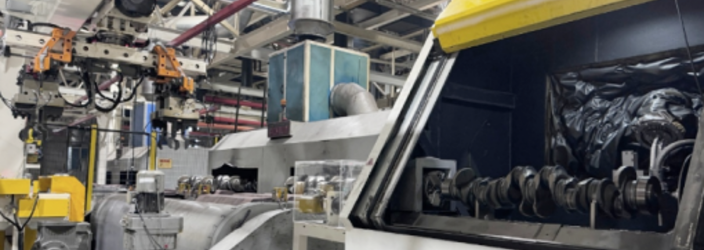
Pain Points:
Long-term exposure to heavy loads, impact, and alternating stresses in harsh environments such as mines and construction sites.
Welded areas contain residual tensile stress and stress concentrations, which serve as initiation points for fatigue cracks.
Surface rust and scale compromise coating adhesion, leading to corrosion protection failure.
Value of Shot Blasting:
Eliminates welding residual tensile stress and introduces a compressive stress layer, significantly improving fatigue strength.
Cleans surface rust and scale, providing an optimal substrate for anti-corrosion coating.
Extends the service life of structural components and reduces equipment downtime for maintenance.
Pain Points:
Subjected to friction, wear, and alternating loads under high-pressure, reciprocating motion over extended periods.
Surface scratches and corrosion pits accelerate seal damage, leading to hydraulic oil leakage.
Fatigue fracture can cause total hydraulic system failure.
Value of Shot Blasting:
Strengthens the surface compressive stress layer, greatly enhancing fatigue and bending strength.
Improves surface micro-topography, reducing friction coefficient and extending seal life.
Suppresses corrosion fatigue and resists combined corrosion from moisture and oil contamination.
Reduces hydraulic system failure rates, ensuring reliable equipment operation.
Pain Points:
Gears are subjected to high contact stress and bending stress during power transmission.
The tooth root area is a typical stress concentration zone, highly susceptible to fatigue crack initiation.
Tooth surface wear leads to reduced transmission accuracy and increased noise.
Value of Shot Blasting:
Strengthens the tooth root area, improving bending fatigue strength and preventing tooth breakage.
Increases residual compressive stress on tooth surfaces, enhancing contact fatigue life.
Improves lubrication retention through micro-dimple oil storage effects, reducing wear.
Reduces transmission noise and improves operator comfort.
Pain Points:
Pins at articulation points bear shear stress and impact loads.
Surface wear and fretting corrosion increase clearances, affecting operational precision.
Fracture can lead to structural collapse or safety incidents.
Value of Shot Blasting:
Enhances shear and impact strength, ensuring connection safety.
Resists fretting fatigue, extending pin service life.
Improves corrosion resistance for wet and muddy working conditions.
Pain Points:
Track shoes directly contact ground rock and gravel, suffering severe abrasive wear.
Subjected to alternating stress and impact loads from the traveling mechanism.
Rust and wear alter track pitch, accelerating damage to chains and drive wheels.
Value of Shot Blasting:
Cleans surface rust and deposits, providing a clean base for painting/coating.
Increases surface hardness through compressive stress, enhancing abrasive wear resistance.
Improves overall fatigue performance, reducing cracking and fracture risks.
Extends track shoe replacement cycles, lowering undercarriage maintenance costs.
Pain Points:
Bucket teeth directly withstand severe impact and abrasion from rock and soil.
High-hardness materials are inherently brittle, prone to chipping or premature fracture.
Must be replaced once worn to a certain degree — a high-consumption wear part.
Value of Shot Blasting:
Eliminates casting residual tensile stress, reducing chipping risk.
Introduces compressive stress to improve impact toughness, delaying crack initiation and propagation.
Densifies the surface, enhancing abrasive wear resistance.
Extends bucket tooth service life, reducing downtime from frequent replacements.